Wobbly railing, soft boards by the door, and nobody has sat out there since the kids moved out.
Deck removal is one of those jobs nobody budgets for, right up until the afternoon somebody's foot goes through a board and the thing stops being a deck and starts being a lawsuit waiting for a cookout.
Deck demolition and removal is steady work for us from thaw to leaf drop, all over the city and the closer suburbs. Ground-level platforms off a kitchen door, screened boxes on a garage roof, two-story wooden porch structures bolted to the back of a frame three-flat. We pull them all down, haul the wood out, and fill the footing holes.
Here is one thing that does not happen on our jobs: a saw run through the ledger board with the siding left hanging open. When a deck comes off a house, we cut it back to good framing, pull every fastener, and get that wall covered and dry the same day, because an open ledger scar behind a downspout is how you end up with a wet joist band by next rain.
What swings the number on a deck demolition is how it was attached, how deep the piers were poured, whether a truck can back down the alley or the whole pile has to be carried out through a gangway, and how much treated lumber is going in the container. Concrete stoops underneath count too.
Keep reading for how we do the work, what it runs, when tearing it out is the wrong answer, and the questions people ask us first. Or just ring us and we will come stand on it with you.
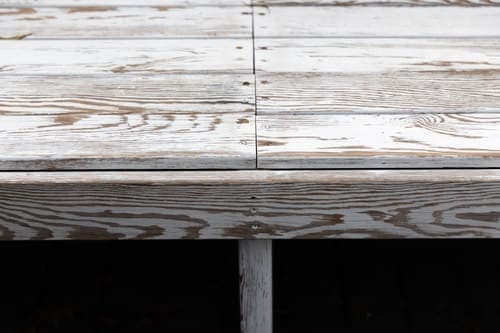
Tearing Down A Deck
Tearing down a deck looks like the simple end of the trade, and it mostly is, right up until you get to the ledger board bolted into the house. That connection is where deck demolition turns into carpentry. Pull it carelessly and you take siding, sheathing and a strip of the rim joist with it, and now you own a hole in the wall instead of an open yard.
We work top down. Decking and railings first, then the joists, then the ledger comes off clean and the wall behind it gets looked at, because water has usually been sitting behind that flashing for years and the sheathing under it is often dark and soft. Posts and concrete piers come next. Those get cut below grade or dug out entirely, depending on whether you want to plant there, pour a patio, or just have grass again.
Most deck removal we do in Chicago sits off the back of a two-flat or three-flat, where the only route out is a gangway too narrow for a machine and a dumpster parked in the alley. That hand-carry is what stretches the hours. Height off the ground, how the footings were set, and whether the pressure-treated lumber is going out board by board all move the day more than square footage ever does.
Underneath, expect pale dead grass, a few decades of bottle caps, and enough old nails that we run a magnet over the whole footprint before we leave.
What the job involves
Deck removal starts at the house, not at the far end, because the ledger board bolted to your rim joist is the only part of this that can hurt the building. We take the boards, the rails and the framing down first, then pull that ledger and look hard at what is behind it.
On older decks off the back of a three-flat, that ledger has sat against siding with no flashing for twenty years and the sheathing under it is punky. Better to find that with the wall open and a crew standing there.
From there it is joists and beams cut into pieces that fit through the gangway, posts out, and the concrete piers dealt with properly. Piers are what people forget. We break them out or cut them below grade so you are not hitting a lump of concrete four inches down the day you decide to seed the yard or pour a patio.
Treated lumber goes out separate, and the yard gets a magnet run, because deck screws and joist hanger nails end up in grass and in lawnmower tires.
Access changes this job more than size does. An open backyard with a clean alley behind it comes apart quickly. A second-story porch served by a narrow walkway means every board leaves by hand. A hot tub, a gas grill line or low-voltage lighting all get disconnected before tearing down a deck gets going.
What it costs
What deck removal costs at your house comes down to what I can see in ten minutes standing in your yard, and size is only the first thing I look at. A low platform off a kitchen door and a second-floor porch hanging off the back of a frame three-flat are two entirely different days. Height means rigging and cutting sections down in pieces instead of prying boards and dropping them.
Access does a lot of the rest. Wide alley, gate off the back, room for the container and a small machine: that is the easy version. A four-foot gangway with the gas meter in it means every joist, post and railing comes out by hand, one armload past your neighbor's hostas.
Footings move it too. Concrete piers go down a few feet, and pulling them out means digging and backfilling. Cutting them off below grade is faster, but if a patio or a garage pad is going in that spot, you want them gone entirely. Composite boards weigh more than treated lumber and dump fees go by weight. A hot tub sitting up there is its own conversation.
Call us with the height, the rough footprint and how you get to the backyard and we will price your deck removal services off that, then confirm it on site.
What I refuse to do is snap posts at ground level and rake grass over the stubs. Your mower finds those in June.
When deck removal is the wrong fix
Deck removal is the wrong answer more often than people expect, and I would rather tell you that on the back porch than after the dumpster lands.
If the posts are plumb, the footings are solid and the joists still ring when you hit them, what you have is a surface problem. Pull the decking, keep the frame, put new boards on it. Tear the whole thing out and you have thrown away sound structure and bought yourself a fresh permit conversation for no reason.
If the deck is fine and the eyesore is the leaning cedar panel next to it, that is fence removal, not this. Same with the dead chest freezer somebody wrestled onto the platform three summers ago and never moved again. That is appliance removal and a hand truck, not a demo crew.
If the water got past the ledger and the room inside has gone spongy underfoot, taking the deck off does not dry anything out. You want the interior opened up first, floor removal down to the framing so somebody can see what the rot actually reached.
And if the garage out back is already on the list, do not do this twice. Deck, shed removal and garage demolition on one mobilization means one dumpster run and one crew day instead of three separate ones. Bundling it is cheaper than phoning us three times over a year.
Why choose us for this
You have a deck out back that has gone from somewhere to sit to something you avoid looking at, and you want it gone without it becoming your whole summer. Deck removal looks simple from the kitchen window. It is not, because the thing is bolted to your house.
The low number you get over the phone usually covers boards and framing and stops there. Then the footings stay in the ground right where you wanted grass, the ledger board comes off and leaves a row of open bolt holes and torn housewrap behind your siding, and the pile of treated lumber in the yard turns out to be yours to get rid of.
We pull the ledger, close up and flash what it was hiding so rain is not running down inside your wall, and haul the wood out ourselves. Treated lumber does not go in your alley cart, and I have watched people find that out the hard way.
The cost to remove a deck swings on whether those footings come out with it, and whether a machine fits through the gate or every board gets carried down a gangway by hand.
Over 34 years at this, one thing I have never done is price a tear-out off a photo somebody texted me. An estimate costs nothing, and after it you are free to do nothing.
What you get back is dirt, not concrete stumps to mow around.
Frequently asked questions
Does deck removal need a permit in Chicago?
Yes, most of the time it does. The city treats a deck as a structure, so taking one off the back of a two-flat goes through the permit desk before the saws come out, and we handle that paperwork as part of the job. Plenty of older back porches were built with no permit at all, and that does not change how they come down, it just means there is no drawing on file to work from. Shared porches on multi-unit buildings get more scrutiny, so tell us up front if neighbors use the stairs.
Will pulling the deck off damage my siding or the wall behind it?
It should not, and the ledger board is where all the care goes. Your deck is lagged to a ledger against the rim joist, often straight through the siding. We cut the fasteners and take the frame off in sections rather than prying the whole band away from the house, then patch and seal the bolt holes so rain is not running into the framing. Expect a stripe of wall that has not seen daylight in twenty years, and sometimes soft sheathing behind it, which we will show you before anything gets covered back up.
Should I just replace the boards instead?
If the posts, footings and joists are solid, new decking over the existing frame is the cheaper road. Once footings have heaved or hangers are rusted through, it makes more sense to demo a deck entirely and start from dirt. Most teardowns are down and hauled off in half a day.
Contact Chicago Demolition now
Contact us now, and a demolition crew can be standing in your yard this week with a tape measure, looking at what is left of that deck. When you call, tell me roughly how big it is, whether it is bolted to the house or free standing, and what sits underneath: piers, a slab, or a patio you want to keep. Two photos from the back steps tell me more than any measurement does.
Deck removal gets interesting the minute we pull the ledger board off your siding, so that is the first thing I check when we walk it. Soft sheathing and chewed-out lag holes behind that board are ordinary on a frame house here, and we patch and flash it back up rather than leaving it for a painter to discover later.
Then I want to see how we get out. Gate width, alley access, whether the truck can sit close or every board gets carried through a side yard in Logan Square with the neighbor's car eighteen inches off the fence. Those are the things that decide whether we demo a deck in one load or three, and they matter more than the square footage anybody quotes you over the phone.
We work weekdays, nine to five, and a message left outside those hours gets a call back. Get in touch and we will put you on the schedule.