Empty storefront, boarded windows, and a roof your insurance carrier keeps writing letters about.
Commercial demolition in this city is mostly a logistics problem wearing a hard hat. We drop storefronts, warehouses, restaurant shells and small office buildings across Chicago and the closer suburbs, and a good share of the work happens before a machine touches brick: utility disconnects, the asbestos survey, the paperwork, and figuring out where a roll-off sits on a street that's already down to one lane because of a delivery van.
Big building demolition tight against an occupied party wall is where careless outfits make the news. We brace what's staying, we keep water on the dust so the neighbors' windows aren't gray by lunch, and the sidewalk stays walkable.
Further down I get into how the job actually runs, what makes one building costlier to take down than the next, and what owners ask before they sign. Call and we will come walk the site with you.
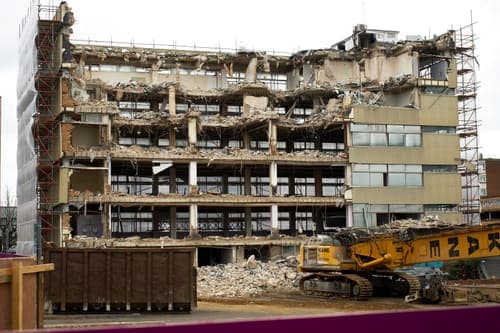
Building Demolition
Building demolition here means the whole structure goes: walls, slab, footings, and every line feeding it. Before a machine touches brick, gas, electric and water get cut and capped at the main, and the asbestos survey either comes back clean or we abate first. Then comes the soft strip, the salvage of anything worth pulling, and the excavator with a shear or a pulverizer on the stick.
A small commercial demolition shell can be flat in two or three days. A masonry warehouse with a basement takes longer, because foundation walls and the floor have to come out and clean fill has to go back.
Water trucks run the entire time. Dust drifting down the gangway onto somebody's car is how neighbors and inspectors both find your site, and that is a bill nobody quoted.
Big Building Demolition
Big building demolition is sequencing work, not swinging work. Before a machine touches steel, we survey for asbestos, have the gas capped at the main and the power killed, then soft strip the interior so what comes down is structure and nothing else. High reach excavators with shears take it in pieces, water trucks running the whole time, because wind off the lake will carry dust a few blocks if you let it.
What I won't do is drop a wall beside a shared party wall without shoring the neighbor first. That is how a teardown ends up as somebody else's ceiling on their floor. Backfill gets the same treatment: clean crushed stone compacted in lifts, not whatever was sitting in the pile.
Size, height, what's hiding in the walls and whether the foundation comes out set the schedule on commercial demolition.
Demolition Of Tall Buildings
Demolition of tall buildings doesn't start with a machine, it starts with a sequence. Nothing gets imploded in this city, so we take the structure down from the top, floor by floor, high-reach excavators on concrete frames, torch crews on steel, and rubble dropped through the core or a chute rather than anywhere near the public walk.
Sidewalk canopy goes up, netting goes on, water runs on the dust, and elevated work stops when the wind off the lake gets strong enough to swing a load.
On commercial demolition at height, the things that move money are the height itself, whether we can take the street or only the alley, how much abatement comes out before machines touch anything, and whether you share a party wall. Overload a slab with debris and you crack floors you meant to keep, which is why structural demolition here is engineered before a single bite is taken.
Building Demolition Permit
A building demolition permit in Chicago isn't a form you drop off in the morning and start swinging on in the afternoon. The city wants an asbestos survey done first, the notification filed with the state, disconnect and cap letters from the gas, electric, water and sewer side, and rodent abatement handled before anything comes down.
We pull all of it, plus the dust control plan and the notice to neighbors, which matters a lot on a tight lot where your wall is somebody else's wall too.
Figure weeks of paperwork, not days, and longer if the survey turns up material that has to be abated before a machine touches the place. That's where cost stacks up on commercial demolition: abatement, utility coordination, and how much sidewalk and street has to be fenced and watered while a demolition of steel structure comes down.
Structural Demolition
Structural demolition is the part where we take out what's holding the place up: bearing walls, columns, beams, the frame under the slab. Order matters. Pull a column before the load above it has somewhere else to go and you get a partial collapse nobody drew, usually leaning toward the alley and somebody else's masonry.
So we work off an engineer's sequence, brace what needs bracing, and bring it down in the direction we picked instead of the one gravity picks. Post-tensioned decks get their own treatment, because in a parking garage demolition those cables hold real energy and have to be released in sequence, not chewed through with a hammer.
Most of the commercial demolition we take on has a neighbor within arm's reach, so cost follows access, shared party walls, and whether the frame is steel or concrete.
Parking Garage Demolition
Parking garage demolition is its own puzzle, because most decks built here after the seventies are post-tensioned, and those slabs are holding cables under live tension. Cut one blind and it whips. So before a saw touches concrete, we scan the deck, locate the tendons and release them in a controlled sequence, working top level down so nothing below is carrying weight it wasn't designed for. Ramps come out last.
What moves the price on a commercial demolition like this is the number of levels, whether any of them are below grade, the headroom you've got for machines, and whether we can drop material to the ground or have to haul it out level by level. A garage sharing a wall with a tenant still open for business becomes selective commercial demolition, and downtown, that's most of them.
Demolition Of Steel Structure
Demolition of steel structure work is its own sequence, and the order of the cuts is the whole job. Open-web bar joists don't sag and warn you first. Release the wrong one and a full bay lets go at once, sideways, which is how a neighbor's roof gets a surprise.
So we walk the frame before anything gets touched, work out what's bolted, what's riveted, what's welded and where the tension is sitting, then take it down bay by bay with shears on a high-reach and torch work where the shears can't get in. Sprayed fireproofing on old columns gets tested before anyone lights up, because some of it is asbestos and hot work makes that airborne fast.
Steel carries scrap value, and that credit comes off the commercial demolition total. Span, height, room for flatbeds, and whether the slab and footings come out as commercial concrete demolition matter more than raw tonnage.
Commercial Concrete Demolition
Commercial concrete demolition is the part of a commercial demolition job that eats the schedule: slabs, dock aprons, footings, grade beams, pile caps, and the mystery pad somebody poured over a floor drain decades ago. We saw the perimeter first, break with a hydraulic hammer on the excavator, pull the rebar and wire mesh out with a magnet, then crush what we can on site so it stays clean fill instead of leaving as mixed debris.
Thickness, reinforcement, how deep the footings run, and whether a machine can physically reach the slab change what it costs to demolish a commercial building far more than square footage does.
And I'm not putting a hammer to a slab before we know what's underneath it. Live conduit or a forgotten sewer lateral turns a clean morning into a shutdown, and post-tensioned slabs get detensioned before anything touches them.
Selective Commercial Demolition
Selective commercial demolition is the version where the building stays up and only part of it comes out: interior partitions, a mezzanine the next tenant doesn't want, a slab opening for new stairs, one masonry wall. We soft strip by hand first, then shore before anything structural moves, and we saw where swinging would be quicker, because in a Loop high rise there's somebody two floors down on a call with a client.
Get it wrong and it shows the same day. Take out a wall that's carrying joist ends and you buy a sag in the ceiling below, plus dust in every return duct in the stack.
What moves the money on this kind of commercial demolition is how much has to be held up while we work, whether debris rides a freight elevator or a chute to a street dumpster, and whether old floor mastic tests positive for asbestos.
What the job involves
Commercial demolition starts weeks before a machine ever rolls onto the lot. We walk the building with you, get the asbestos survey done, and have gas, electric, water and sewer killed and capped at the main, because nobody should be swinging an excavator at a structure that's still live. Then soft strip: interior finishes, fixtures, ductwork, anything with salvage value going out the door first.
We set protection on the shared wall next door, run water on the work to hold the dust down, and bring the shell down in sections, sorting brick, steel and clean fill as we go. Then the hole gets backfilled and graded flat.
People ask about commercial demolition cost per square foot like it's one fixed number. Square footage moves it less than street access, how much abatement the survey turns up, and what's sitting under the slab.
What it costs
What it costs on a commercial demolition job comes down to a short list, and square footage is only the first item on it. Everybody wants a commercial demolition cost per square foot, which is a fair starting point right up until you set two identical footprints side by side: one freestanding with a wide alley, one sharing a party wall downtown with a sidewalk closure to arrange. Structure moves it too.
Heavy timber comes apart faster than reinforced concrete, and salvage steel can push the other way. Asbestos in pipe wrap or floor tile means abatement before a machine touches a thing. Then foundations: how much footing and slab leaves the site, and what clean fill comes back. Call us with an address and a rough size and we will price your actual site. Frozen ground in January adds hours to the digging.
When commercial demolition is the wrong fix
Sometimes commercial demolition is the wrong fix, and we would rather say that up front. If the structure and roof are sound and what you actually hate is the drop ceiling, the partition walls and forty feet of abandoned plumbing chase, that is interior demolition. Knock the shell down to fix a build-out and you have paid to lose a building that was fine.
Heaved loading dock apron, sunken walk, cracked pad out back? That is commercial concrete removal, and the thickness, the rebar and how close a machine can get to it move that price far more than square footage does.
On mixed-use property the small jobs stay small too. A courtyard pool removal, a hot tub removal off a roof deck, a soft deck removal behind a tavern. Those are afternoon work with a compact excavator and a dumpster.
Why choose us for this
You've got a structure that's done earning its keep, a lender or a tenant waiting on a clear site, and you want to hand the whole commercial demolition to one outfit and not babysit it. Reasonable thing to want.
The low number on a job like this usually gets there by leaving items off the sheet. Dust control and the water truck. Utility disconnects and caps. The asbestos survey. And the slab, footings and foundation walls still sitting in the dirt after the walls come down. Commercial concrete removal that stops at grade looks like a saving right up until somebody's excavator finds a two foot thick wall nobody mentioned.
Over 34 years doing this, and we don't quote a clear site and then hand back a hole with concrete in it. Size, access and what's buried move the number.
The estimate costs you nothing, and booking stays your call.
Frequently asked questions
What are the three types of demolition?
In commercial demolition the three you'll hear about are selective, mechanical and implosion. Implosion almost never happens on a Chicago block, there's nowhere to put the dust. Nearly everything we do is mechanical, with hand work where the structure touches something that's staying up.
Will knocking it down crack the building next door?
Not if the party wall is treated as a wall instead of debris. Half the older commercial stock here shares masonry with its neighbor. We cut back by hand near the line, brace and weatherproof what's left, and watch vibration while the machine works.
What changes what a teardown costs?
Size, access and what's under the slab. Add hazardous material abatement, alley width for the trucks, and frozen ground in February slowing the below-grade work.
Contact Chicago Demolition now
Ready to move on commercial demolition at your building? Call us and give me the address. There are things nobody can tell me over the phone: how close the neighboring wall sits, whether the alley takes a full size excavator or we have to work off the street, where gas and electric come into the slab, and whether there is asbestos in the pipe wrap or floor tile that has to come out under survey before a machine touches anything.
That survey and the utility disconnects run on their own schedule, and they set your start date more than the square footage does. So call early rather than late.
Most of our week is commercial demolition work across the city, storefronts on Western Avenue one day, a warehouse shell the next. Weekdays, nine to five, and a message gets returned. Licensed, bonded and insured, proof available if you want to see it.